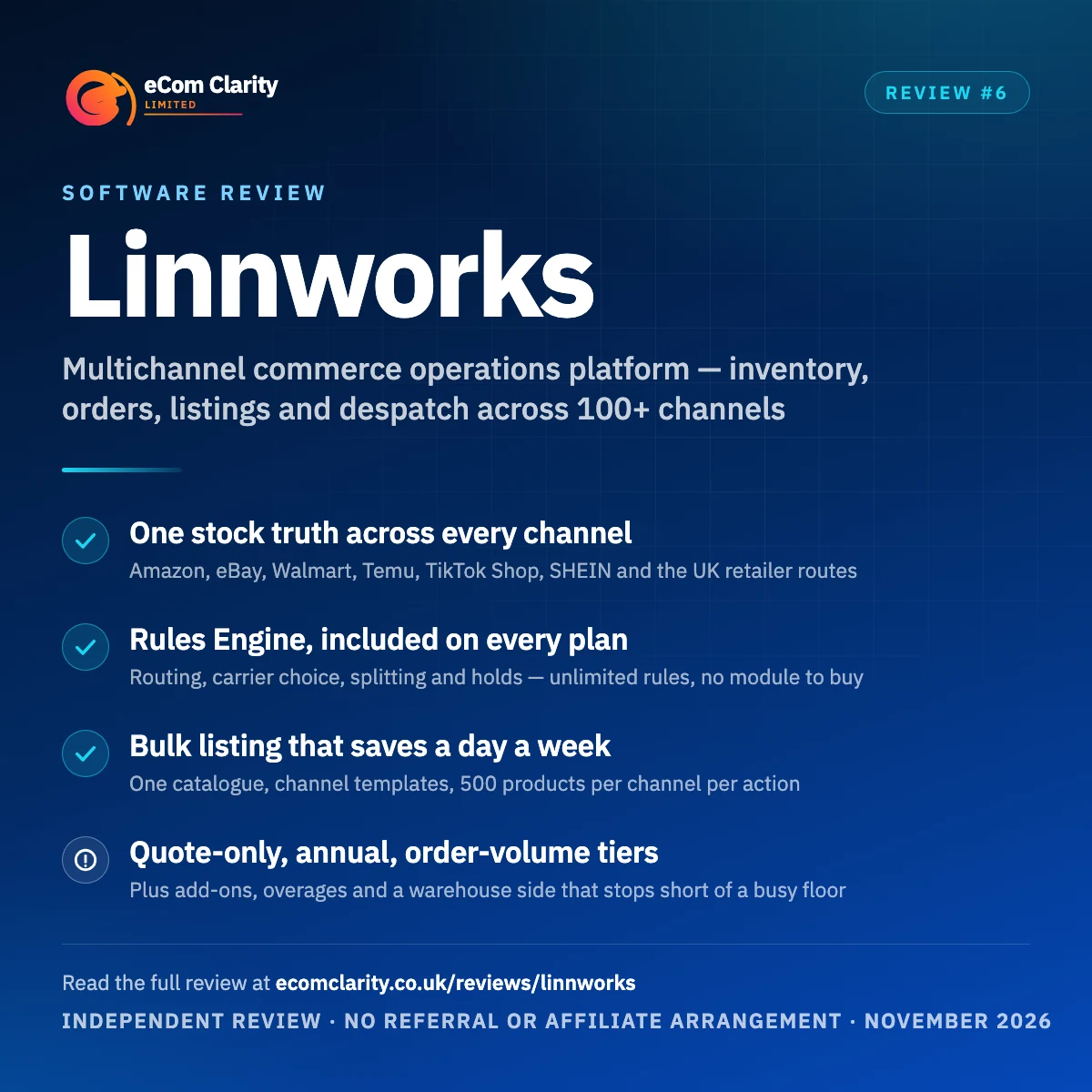
What Linnworks is, and what it is not
Linnworks is a multichannel operations platform. That means one stock record, one order queue, one listing catalogue and one despatch process across every channel a seller trades on, with the platform deciding where each order should be fulfilled. Its centre of gravity is the join between channels, not the inside of a warehouse. The warehouse tools are real — bin locations, digital picklists, scan verification at pick and pack, wave picking — but they exist to serve the orders the platform is already holding, which is a different design brief from software built to run a picker around a building all day.
The vendor’s own phrase is “connected commerce operations”, and the jargon is worth translating: Linnworks sits between your channels and your fulfilment, decides which order goes where, and keeps the stock figure the same everywhere. Where that matters most is the hour after a promotion goes live, when the same item is being sold on six channels and every one of them believes it still has stock.
The company is twenty years old, which is unusual in this part of the market. Linnworks was founded in 2005 and bootstrapped until Marlin Equity Partners took a majority stake in September 2021. It bought SkuVault in 2022, which is where its deeper warehouse features came from, and SkuVault now trades as SkuVault Core by Linnworks. A new leadership team arrived in 2025 with Jon Bahl as chief executive. The vendor claims 4,000-plus customers, 18 billion dollars of GMV and 250 million orders a year through the platform, and holds ISO 27001 for information security. Those figures are the vendor’s own and I have not audited them, but they are specific enough to be checkable, which is more than most claim pages manage.
The boundary that decides whether it fits
Linnworks assumes a fulfilment operation but not necessarily your own warehouse: it routes to a 3PL, to Amazon FBA, to a dropship supplier or to your own floor, and that flexibility is genuinely good. What it is not is a warehouse system for a demanding floor. If your picking operation is the thing that is breaking, buying Linnworks alone will not fix it, and the evidence for that is in the second half of this review rather than in the vendor’s demo.
How this review was done
Most software reviews are written from a demo and a pricing page. This one has a different shape from our Peoplevox review, because our relationship with the two products is different: we ran Linnworks ourselves for orders and stock, and we ran the warehouse on Peoplevox alongside it. So the judgements about how the two fit together, and about what Linnworks is genuinely good at, come from operating it. The judgements about pricing, packaging, support and road map come from the vendor’s published pages, read on the dates below, so you can check them and argue with them.
- The pricing page and its plan FAQ, read 12 November 2026
- The feature and solution pages for inventory, order management, listings, shipping, warehouse management, forecasting, reporting and AI
- The onboarding and implementation page, read 12 November 2026
- The support centre, partner directory and integration sitemap, read 12 November 2026
- The About page and company timeline, for ownership, history and the SkuVault acquisition
- Public customer reviews on Trustpilot and TrustRadius, read 12 November 2026
- Our own experience of running Linnworks for orders and stock, with the warehouse on Peoplevox
Two limits worth stating. I have not run the current 2026 build, so what follows about Spotlight AI and the present interface is read from the vendor’s own recorded demos, which are embedded here so you can judge the same footage I did. And where customers complain about price or support, I am reporting a pattern in public reviews, not an audit of any individual account. Both caveats are cheaper than pretending to a certainty the evidence does not support.
What it actually does
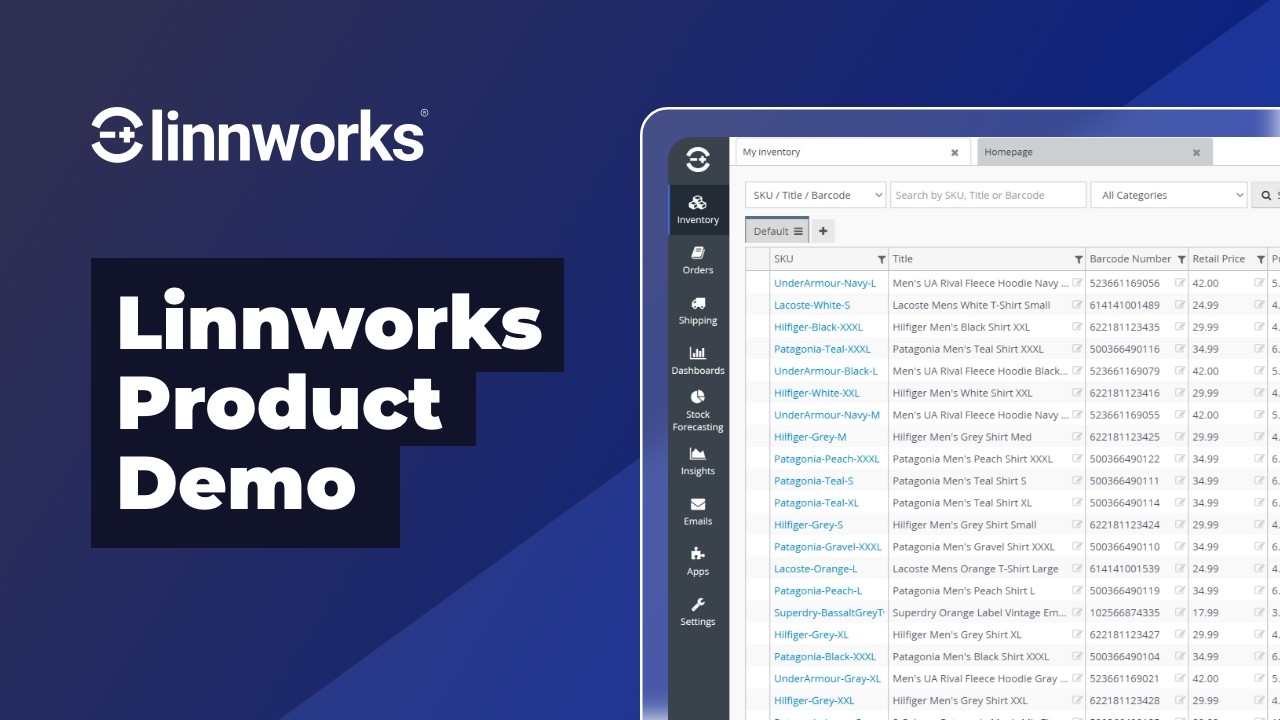
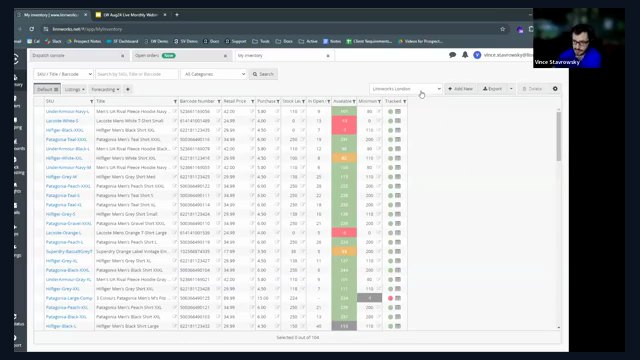
Linnworks publishes an unedited screen recording of the platform, rather than the usual animated explainer, which is the single most useful thing a vendor can put in front of a buyer. It runs over twenty minutes because the product has more in it than a two-minute overview can carry. Watch the left-hand navigation as it goes: inventory, orders, shipping, dashboards, stock forecasting, insights, emails, apps, settings. That list is the product.
Inventory
One product record per item, a stock figure per location, and that figure pushed to every connected channel. Bin locations, warehouse transfers, purchase orders, low-stock replenishment alerts, kits and bundles with component stock deducted as they sell. Lots with FIFO and FEFO ordering, serial numbers and quality control are in the SkuVault side of the product and marked North America only, which matters more than a footnote and is covered below under the warehouse.
The sync claim is worth reading precisely, because it is the number the entire proposition rests on. The homepage says stock updates “instantly” in one section and “every few minutes, faster than most marketplaces refresh themselves” in another. The feature page says “in moments”. The specific claim, and the one I would believe, is minutes: Linnworks is usually quicker than the channel it is pushing to, and the practical protection comes from that relative speed rather than from anything resembling real time. For an operation selling single items of scarce stock, that difference is the whole ball game. Ask what your worst case looks like when two orders land on the same SKU on two channels within the same minute.
Orders, and the Rules Engine
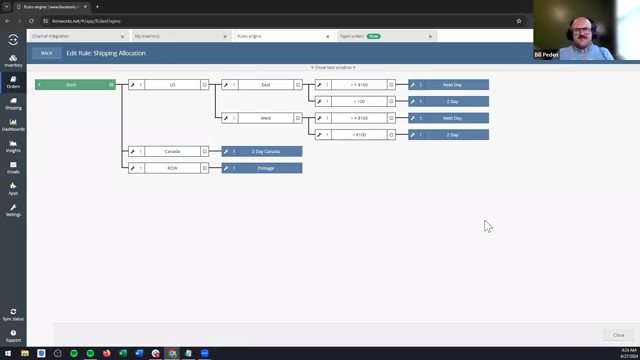
This is the part of Linnworks worth paying for. Orders download from every channel into one queue, and before your team sees them the Rules Engine has already applied your logic: assign a carrier and service by weight, destination or channel requirement, route to a warehouse or a 3PL or FBA, tag for special handling, sort into folders, split by value or weight, or hold for review. Rules are unlimited, several can fire in sequence on one order, and the vendor includes the engine on every plan rather than selling it as a module, which is the right commercial decision and rarer than it should be.
The useful detail is the per-team view. Packing sees a queue built for packing, the warehouse manager sees a different one, and neither is a filtered copy of the other. That sounds cosmetic until you have watched a team argue about whose screen is right. Order splitting and merging, and single-click actions that combine print, assign and advance, are the other things that remove real seconds from real days.
Listings
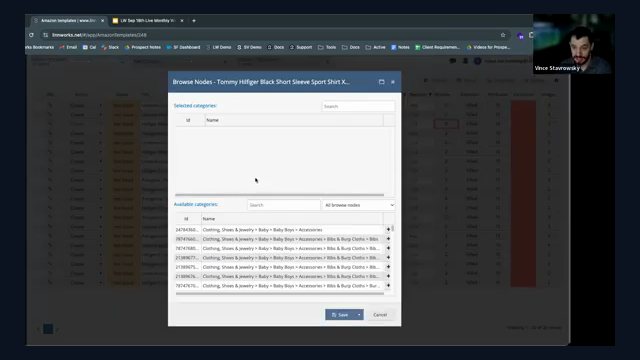
A central catalogue feeds every channel: one product record, channel-specific templates that map your fields to each marketplace’s required attributes, per-channel titles, content and prices, and bulk creation or revision of up to 500 products per channel in one action, with required fields flagged before publication. Anyone who has listed a few hundred SKUs onto a new marketplace by hand will recognise what that saves. Listings management is sold as a paid add-on rather than being in the base platform, which is one of the places the packaging gets muddier than the marketing suggests.
Shipping
Seventy-plus carriers, either direct — Royal Mail, DPD, Evri, FedEx, UPS, DHL Express, Amazon Shipping, InPost, Deutsche Post — or through an aggregator such as Shippo, ShipStation, EasyPost, Parcelhub, SmartConsign or Sendcloud. The commercial point matters as much as the technical one: you connect your own carrier accounts, so you ship on your negotiated rates rather than a platform mark-up, rates come back live per order for the rules to act on, and tracking writes back to the originating channel automatically. Linnworks claims 246 million labels a year through the platform. I have not verified that figure, but the architecture it describes — your accounts, your rates, one workflow — is the right one and is not universal.
The warehouse
Bin locations and zones, digital picklists that run on any mobile browser, barcode scan verification at the shelf and again at the pack bench, wave picking that consolidates picks across open orders into one pass, and multi-location stock across warehouses, 3PLs and dropship. For a growing seller doing a few hundred orders a day from one site, that is enough, and it is a good deal more than the order-management tools it competes with offer. Where it stops, and why we kept a separate warehouse system, is covered in its own section below rather than buried here.
Forecasting
The built-in module forecasts from your own sales history by channel and location, adjusts as current sales move, sets target stock levels up to supplier level, and turns the result into suggested reorder quantities and dates, or straight into purchase orders. Seasonality is a manual input, though, and that is the honest boundary: it is a good reorder-point engine, not a demand-planning suite. For trend, seasonality and spike analysis, open-to-buy and a couple of hundred inventory metrics, Linnworks points you at Inventory Planner, which is a separate product and a separate contract. Stock forecasting is also a paid add-on to Linnworks Advanced, and the vendor says it is a flat fee rather than order-volume priced.
Reporting
Dashboards for financial, inventory and order performance, reporting down to SKU and channel rather than only at the top line, custom reports with filters for stock history, channel, category, period and refunds, and export in a few clicks. The standard KPIs are the ones you would ask for: sales volume, revenue, order counts, stock levels and value, refunds, fulfilment performance, channel profitability. For true product margin after advertising and carriage, Linnworks integrates with Conjura as an add-on rather than building the maths itself. That is a sensible division of labour, and worth knowing before you assume the platform will tell you which products actually make money.
Spotlight AI
The 2026 addition, and the one to be clear-eyed about. Spotlight AI watches the repetitive actions your team performs inside Linnworks — assigning carriers, sorting, routing — quantifies the hours each is costing, and tells you which rule to build to remove it. It does not build the rule for you, and Linnworks says so plainly in its own FAQ, which is to its credit. It monitors a focused set of repetitive behaviours rather than everything, and it is included in every plan rather than sold separately. The vendor’s headline is 52 hours a month saved on average. Treat that as a claim about customers who acted on the advice, not as a property of the software: the value is in the rules you then build, and the engine that runs them has been there for years.
Where it is genuinely strong
I have used a lot of these platforms, and Linnworks is the one I would still put in front of a marketplace-heavy business first. Four things earn that.
- The Rules Engine. It decides the same way at 50 orders a day and at 50,000, it is included rather than metered, and it is the difference between a team that processes orders and a team that handles exceptions. Most of the operational benefit of the platform flows through this one feature.
- Channel breadth that includes the awkward ones. Amazon with FBA, MCF, Seller Fulfilled Prime and Amazon Shipping; eBay; Walmart; Temu; TikTok Shop; SHEIN; Zalando; Allegro; OnBuy; Wayfair; Fruugo; Back Market. Add the UK retailer routes — B&Q, Tesco, The Range, Dunelm, Debenhams, Decathlon, Wowcher — and the pattern is obvious: this is a British product that grew up serving British sellers, and it shows in the connector list rather than in the case studies.
- Adding a channel is configuration, not a project. Once your catalogue and rules exist, a new channel is a template and a credential, and the same inventory logic applies immediately. That is what makes testing a marginal marketplace economically sensible instead of a six-week argument.
- Bulk listing at volume. Set-up is fiddly — templates take work — but once they exist, listing and revising hundreds of products across channels in one action is the sort of unglamorous capability that quietly saves a day a week.
Beneath that sits a real API and a developer portal, and it is more open than the marketing lets on. Snag, one of the vendor’s own case studies, has built 19 custom apps on top of it rather than replacing it. We have used that openness ourselves: when we needed Linnworks to feed a warehouse system and no connector existed, the connection was buildable from the outside. A platform that lets you build around it is worth more than one with a richer feature list and a closed door.
The vendor’s case-study numbers should be read as what they are — the vendor’s case studies, not independent research. Worth knowing the shape of them all the same: Homescapes Europa processing 1,500 parcels a day and moving to thousands of orders a day; Source BMX to 5 million dollars of revenue in its first year with 100% inventory accuracy after migration; Rinkit cutting manual errors by 98%; Dynergy cutting manual tasks to 78 a month; Spreetail six times growth in Europe with a distribution centre live in three weeks. The consistent thread is not efficiency in the abstract, it is doing more volume with the team you already have.
The warehouse question: why we kept Peoplevox
We ran Linnworks for orders and stock, and the warehouse ran on Peoplevox. That was not sentiment; it was a judgement about where each product was strong. Linnworks held the truth about what we had and what had been sold, and routed work to the floor and to the channels. Peoplevox told a picker where to walk, made them scan, and took the order through pick, pack and despatch. The join between the two was the interesting part, and it was the reason we ended up specifying a connector rather than living with a nightly export.
That connector is Linn2PVX. We set the brief, Oddsphere built it and still runs it, and Linnworks clients are still on it. We do not use it ourselves any more, having moved to Sellercloud, but it exists because both ends were open enough to connect without either vendor having to bless the idea. If you are reading this because you are weighing Linnworks against a warehouse system, that is the practical answer: they are not rivals, and the sensible architecture for a busy operation is often one of each. The question is whether you can afford the join, in money and in maintenance, and whether the two vendors will support you when it breaks at 4pm.
Where the warehouse side runs out
Read the Linnworks pages in sequence and you get three different accounts of its warehouse depth, and the difference is not pedantry. The warehouse management solution page describes barcode-verified pick and pack, wave picking, zones and bins as part of the product, and then says that in North America SkuVault Core adds quality control, serialization, product substitution and 3PL inventory management with a client portal. The Enhanced Warehouse page, which is where kits, lots, serialization, 3PL and wave picking are described in detail, carries a banner saying those features are only available in North America. And the pricing page marks quality control, 3PL and product substitution as North America only but lists serialization and lot management without that caveat.
I am not suggesting anything dishonest is happening. The likely explanation is a product built from two codebases — Linnworks and the acquired SkuVault — with a road map that is mid-migration, and pages written at different times by different teams. But a buyer in the UK or Europe cannot tell from the public site which of those warehouse capabilities they will get, and that is exactly the sort of thing to resolve in writing before signing rather than after. Ask for the entitlement list for your region, feature by feature, and keep it.
The other signal is that Linnworks’ own partner directory carries warehouse bolt-ons — Warehouse Plus is one, built by a Linnworks partner and sold to Linnworks clients as an extra picking and stock-in layer. When a platform’s ecosystem fills a gap, the gap is real. If your picking is simple, one site, a few hundred orders a day, you will not notice. If you are running pick waves, multiple zones, agency staff at peak and a 99.5% accuracy target, you will notice within a fortnight.
What it costs, and why you cannot see it
Linnworks does not publish prices. The pricing page says pricing is “tailored to your exact needs” and asks you to speak to a specialist, which is a choice rather than an oversight, and it changes how you should evaluate the product. You cannot compare Linnworks with a rival without a call, and you cannot sanity-check a quote against anything except another quote.
What the page does tell you, and these are its own words: plans are priced on order volume, not revenue, with no percentage fees; add-on modules carry the advanced functionality; and every package includes a guided onboarding plan. The plan FAQ adds the details that matter: pricing is tiered on monthly orders and overages apply if the number is exceeded; Linnworks Listing, Linnworks WMS and SkuVault Enhanced Warehouse are also priced on order count; and Linnworks Forecasting is a flat fee.
| What you pay for | How it works | What to pin down |
|---|---|---|
| Base platform | Tiered on monthly order volume | Which tier you land in, and the threshold that moves you up |
| Overages | Charged when the monthly order count is exceeded | Whether peak months are billed at the overage rate or averaged |
| Add-on modules | Listing, WMS, Enhanced Warehouse (order-volume priced); Forecasting (flat fee) | What is already in the base tier — the site is not consistent about this |
| Onboarding | One-off, quoted on channels, data and workflow | Fixed fee or time-and-materials, and what migration it covers |
| Third-party extras | Inventory Planner, Conjura analytics | Separate contracts, separate support |
Two things about that structure deserve attention before you compare a quote with a rival’s published price. The first is the overage. Order-volume pricing means your bill is a function of your busiest months, and a business that doubles its November needs to know whether it is charged at the new tier for December or billed an overage for one month and reset. The second is what counts as an order. One reviewer on TrustRadius claims Linnworks “charges you for every FBA order it doesn’t fulfil”, and I could not verify that from the pricing page, which simply says pricing is tiered on monthly orders. It is a fair question regardless: if orders routed to FBA, a 3PL or a dropship supplier count towards your tier and your overage, your effective cost per order you physically handle is higher than the headline suggests. Ask, in writing.
The contract is annual, and that is the real lock
The plan FAQ is unusually blunt: if you are in contract you are expected to fulfil the obligation in full, and downgrades or new terms are discussed at the end of the contract. Billing in the UK and Europe runs on Direct Debit through GoCardless or bank transfer; credit cards are not accepted in the region. So the decision you are making is a year-long one, not a monthly one, and the time to test the awkward things — a peak month, a carrier change, an overage — is before the contract starts rather than during it.
Price rises are the loudest theme in public reviews. A TrustRadius reviewer wrote that Linnworks “quadrupled the price for no increase in service” and gave them a week to find another provider. A Trustpilot reviewer in February 2026 wrote of “price increase after price increase”. These are customer claims about their own contracts and I cannot audit them, but they are consistent, they recur across two independent platforms, and they fit a private-equity-owned company with a new leadership team and an expanding product suite. The practical response is not to avoid Linnworks; it is to ask what the uplift mechanism is, whether it is capped, and what notice you get.
Do the arithmetic on orders rather than on features. At a few hundred orders a day, the annual cost of the platform plus onboarding and one or two modules is a real number, and it stacks against the salary of the person doing the manual work it removes. For most sellers past that point, one avoided peak-season failure pays for the year. Below about a hundred orders a day with simple products, it rarely does, and your channel platform probably already does enough.
Implementation: 40 days is the fast end
Linnworks gives three different timelines depending on which page you read. The homepage FAQ says customers go live in “as little as 30-40 days”. The onboarding page says “as little as 40 days”. The support FAQ says the average setup time for Linnworks One, based on projects started this year, is about 60 days. None of those contradicts the others — the first two are the best case, the third is the average — but read together they tell you the honest shape: plan for six to eight weeks, and treat anything faster as a bonus.
Onboarding is a paid service, scoped to your setup, and it is structured rather than self-serve: a dedicated specialist, a discovery session and a written plan, data migration of your SKUs, setup and training sessions, then testing and go-live with the specialist still alongside you. The vendor’s own framing is that the fee depends on the timing of your implementation and the resources you have internally, which is a polite way of saying that it costs more if you want it sooner or need more help. Get it fixed rather than estimated.
Ask what migration actually covers
The onboarding page says Linnworks experts “help you move your SKUs”, and the case studies credit migration with the accuracy that followed. It does not publish what is included — SKUs only, or stock, open orders, listing templates, supplier records, historic sales — and it does not say who is responsible when a SKU arrives with the wrong stock figure. Migration is where these projects overrun, and a blank answer here is more expensive than a long timeline.
Support: a ticket queue, a status page, and no SLA
Support runs through a ticket portal in the support centre, with a customer success team alongside it and urgent technical issues handled case by case by an on-call team at weekends. That is a normal shape for a platform of this size, and the support centre itself is better than most: the knowledge base carries current articles on things like the EU customs changes in 2026, Royal Mail’s product-level compliance requirements from October 2026, and carrier migrations such as DPD Local and InPost UK. A vendor whose help centre is up to date on customs and carrier changes is a vendor whose support team is close to the product.
What Linnworks does not publish is a response-time SLA, a severity matrix or an uptime commitment. There is a public status page, and the platform is ISO 27001 certified, but neither of those is a contractual promise about how fast someone answers when your labels stop printing on the busiest day of the year. If uptime and response times matter to your operation — and at peak they should — ask for both in writing and compare them with what the alternatives will put in a contract.
Public reviews split on this exactly where you would expect them to. The positive ones name individual people — account managers and onboarding specialists who went beyond the brief — and there are a lot of them. The negative ones describe urgent issues taking days to acknowledge and being batted back as not-a-bug, including one review from March 2026 that says the product is decent but support is “atrocious, almost comical”, and that the internal joke is that it is not worth reporting an urgent issue at all. That is one customer’s account of one relationship. But the pattern — good named humans, variable queue — is worth pricing into your decision, particularly if you run lean and have nobody spare to chase a ticket.
Integrations: the reason people choose it, and the numbers to check
Linnworks advertises “100+ native channel integrations”, “300+ marketplaces via the Mirakl network”, “200+ integrations” in the partner directory and “70+ carrier integrations”. Those are four different measures of four different things, and the integration sitemap carries 144 individual integration pages. None of that is dishonest, but none of it tells you whether the specific channel or carrier you need is native, partner-built or missing. Check your own list by name, in the demo, and ask who supports each connector when it breaks.
| Group | Examples from the public directory |
|---|---|
| Marketplaces | Amazon (incl. FBA, MCF, Amazon Shipping), eBay, Walmart, Temu, TikTok Shop, SHEIN, Etsy, Zalando, Allegro, Bol, Fruugo, OnBuy, Wayfair, Reverb, Newegg, Back Market, Refurbed |
| UK retailer routes | B&Q, Tesco, The Range, Dunelm, Debenhams, Decathlon, Wowcher, Rackhams, Checkatrade |
| Web platforms | Shopify and Shopify Plus, Shopify POS, BigCommerce, Magento, WooCommerce, Shopline, Bluepark, Faire, SparkLayer |
| Shipping and 3PL | Royal Mail, DPD, Evri, FedEx, UPS, DHL Express, Amazon Shipping, InPost, Shippo, ShipStation, EasyPost, Parcelhub, SmartConsign, Sendcloud, ShipBob, ShipMonk, CIRRO, SPS Commerce, Logicbroker |
| Accounts and analytics | QuickBooks Online, Conjura, Inventory Planner, Cogsy, StockTrim, Hyperstock, Optiseller, Repricer.com |
Two things a buyer should take from that table. The UK retailer routes are the tell: a US-first platform would not carry B&Q, Tesco, Dunelm and The Range as named connections, and if you sell through British retailers’ dropship programmes, that is a large part of the value. And accounting is thinner than the rest — QuickBooks Online is the connector the site names, and there is no Sage or Xero equivalent in the public directory. If your finance team runs Sage, that is a conversation to have early rather than an assumption to carry into signing.
The vendor’s own position is that if a native integration does not exist, the partner network does. Treat that as an invitation rather than a promise: a partner-built connector is a different support path and sometimes a different company, and the accountability when it fails is worth establishing in advance. It is also the mechanism by which a missing integration becomes a billable project rather than a feature request, which is fine if you know it is coming.
The areas of concern, in one place
None of these is a reason to walk away. Together they are the list I would take into a negotiation, because every one of them is answerable before you sign and expensive to discover afterwards.
- The packaging is unclear. The site refers to Linnworks One, Linnworks Advanced, Linnworks WMS and Linnworks Listing, and describes listing and forecasting as both included capabilities and paid add-ons, depending on the page. Ask for an itemised entitlement list against a named package.
- The warehouse feature set varies by region. Quality control, serialization, product substitution and 3PL inventory management with a client portal are North America only; the Enhanced Warehouse page gates wave picking, kits and lots behind the same banner while the warehouse solution page presents several of them as standard. Get your region’s list in writing.
- Pricing is invisible and volume-based. No published price, tiered on monthly orders, with overages. You cannot compare it without a call, and a growth year raises the bill by design.
- The contract is annual and the exit is procedural. Downgrades happen at renewal, cancellation runs through a support article, and billing in Europe is Direct Debit or transfer. Read the term before you are in it.
- Price rises recur in public reviews. Two independent review platforms carry the same complaint. Ask what the uplift mechanism is and whether it is capped.
- Support has no published SLA. Named people when it goes well, a queue when it does not, and no contractual response time to hold anyone to.
- Sync is minutes, not instant. The proposition depends on Linnworks being faster than the marketplace it is pushing to. On scarce stock, understand the worst case.
- The warehouse gap is real enough that partners sell into it. If picking is your bottleneck, you will end up with a second system or a bolt-on, and that decision is better made at the start.
Who it suits, and who it does not
A good fit when
- You sell through several marketplaces and your own site, and the reconciliation between them is already a job
- You are doing a few hundred orders a day or more, and hiring is how you have been absorbing growth
- You need the awkward channels — Temu, TikTok Shop, SHEIN, Zalando, OnBuy, or the UK retailers’ dropship routes
- Your fulfilment is mixed: your own warehouse plus a 3PL, FBA or dropship suppliers, and orders need routing between them
- You want one place for listings, prices and stock rather than a marketplace-by-marketplace routine
- You can plan and staff a six-to-eight-week implementation, and you would rather buy a proven engine than the newest AI feature
Not such a good fit when
- Your bottleneck is the floor: pick waves, zones, agency staff, accuracy targets. Buy a WMS, or run Linnworks alongside one as we did
- You are a 3PL. The client portal and 3PL billing that make that business work are not what this platform is for
- You need published pricing to build a business case before you will take a call. Linnworks will not give you one
- You are under about a hundred orders a day with simple products: the platform is more than the job, and your channel tool probably already does enough
- Your finance function is built on Sage or Xero and you expect the platform to feed it natively
What to ask Linnworks in a demo
- Show me my order tier and my overage rate, and tell me which orders count towards both — including FBA, 3PL and dropship orders you do not physically fulfil.
- Give me the entitlement list for my region, in writing, for listing, wave picking, lots, serialization, quality control and the 3PL portal.
- What is the all-in first-year figure: platform, modules, onboarding, integrations, and anything partner-built?
- What is the uplift mechanism on renewal, is it capped, and what notice do I get?
- Who migrates my SKUs, stock, open orders and listing templates, what does that cost, and what happens when a figure arrives wrong?
- Which of my channels and carriers are native, which are partner-built, and who supports each one at 4pm on Black Friday?
- What is your response-time commitment, and where is it written? Show me the escalation path for a stopped despatch.
- Show me a real peak day from an account my size: how many orders, how many rules, how many exceptions, and what the team actually did.
- Walk me through a mis-pick and a duplicate order. How is each caught, who is told, and what does the customer see?
- Once my rules exist, how long does a new channel take to go live, and who does the work?
The verdict
Linnworks does the hardest part of multichannel retail better than anything else I have run: it holds one truth about stock and orders across a dozen channels, and it applies your rules to every order without a person making the same decision three hundred times a day. That engine is included rather than metered, it is open enough to build on, and the connector list is deep in exactly the places a British seller needs depth.
It is not a warehouse system, and the vendor’s own pages are inconsistent about how far the warehouse features go and where. We ran Linnworks for orders and stock and kept the warehouse on Peoplevox, and if I were starting again with a busy floor I would make the same call — either with a dedicated WMS beside it or by accepting that picking will be competent rather than excellent.
The commercial side is where I would push hardest. No published price, an annual contract, order-volume tiers with overages, add-on modules whose boundaries move between pages, and a pattern of price rises in public reviews from customers who felt them. None of that is unusual in software owned by an investment firm. All of it is answerable before you sign, and none of it should be discovered in year two.
Would I recommend it? Yes — to the multichannel seller whose problem is channels rather than picking, who is prepared to spend six to eight weeks implementing properly, and who will negotiate the contract rather than accept the first quote. On that brief it is the platform I would put in front of you first. Ask it the awkward questions above, get the answers in writing, and it will keep earning its place for years.
Evidence and sources
- Pricing page and plan FAQ: order-volume tiering, overages, add-on modules, onboarding guidance · Read 12 November 2026
- Solution and feature pages: inventory, order management, listings, shipping, warehouse, forecasting, reporting, AI and automation · Read 12 November 2026
- Enhanced Warehouse page, including the North America availability notice · Read 12 November 2026
- Onboarding and implementation page: timeline, migration, training, go-live · Read 12 November 2026
- Support centre and FAQ: ticket model, weekend cover, billing, contract and cancellation terms · Read 12 November 2026
- Partner directory and integration sitemap: 144 integration pages across channels, carriers, 3PLs and analytics · Read 12 November 2026
- About page and company timeline: 2005 founding, SkuVault 2022, leadership change 2025, Spotlight AI 2026 · Read 12 November 2026
- Marlin Equity Partners press releases: majority investment September 2021, SkuVault acquisition September 2022 · Read 12 November 2026
- Public customer reviews on Trustpilot (3.9/5) and TrustRadius, including complaints about support and price rises · Read 12 November 2026
- Linnworks product and demo videos on the vendor’s own YouTube channel · Viewed 12 November 2026
- Our experience running Linnworks for orders and stock, with the warehouse on Peoplevox, and the Linn2PVX connector brief · Author’s own
Independence
eCom Clarity was not paid for this review and Linnworks has no influence over its content. There is no referral or affiliate arrangement. It mixes material read on Linnworks’ own pages on the dates in the sources list with our experience of running Linnworks for orders and stock while the warehouse ran on Peoplevox. Where a point comes from that experience rather than the vendor’s paperwork, it says so, and where it comes from a public customer review, it is attributed rather than asserted.
Spotted something wrong, or used this product yourself? Tell us and we will correct or add it.