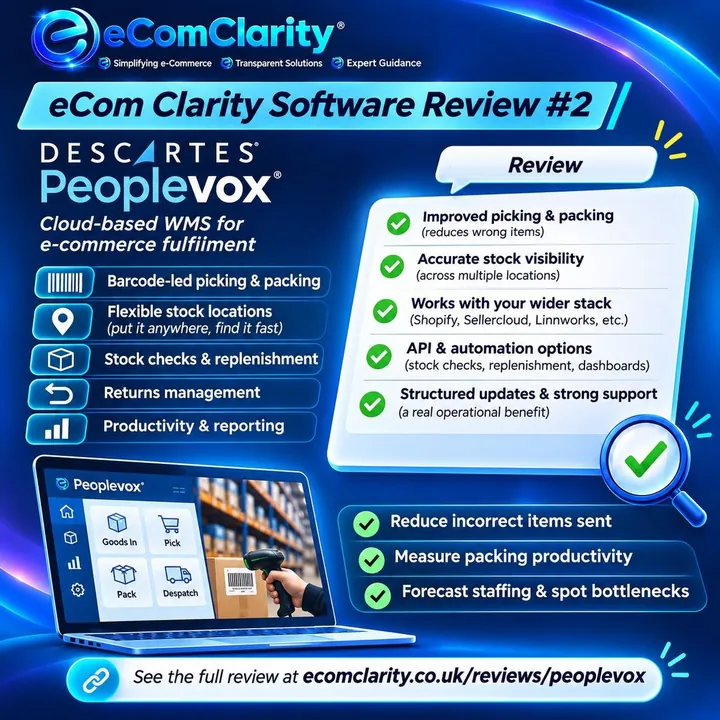
What Peoplevox is, and what it is not
Peoplevox is warehouse management software for ecommerce fulfilment. In practice that means it tells a picker where to go, makes them scan what they picked, and gets the parcel onto the right carrier with the right label. It thinks in units and orders rather than pallets, which is the distinction that matters in a D2C warehouse, and the reason so much “proper” WMS software feels wrong in one.
It’s a Descartes brand now. The site calls it Descartes Peoplevox throughout, the footer carries the Descartes copyright, and support runs through Descartes. Commercially that matters more than technically: you get group neighbours like Sellercloud for order and inventory, ShipRush for carrier rates and ForecastMine for demand planning, plus a listed parent behind a product that started life as a specialist.
The boundary that decides whether it fits
Peoplevox assumes you run your own warehouse. If a 3PL holds your stock, the warehouse management is their problem and your problem is visibility into it. A WMS licence isn’t the answer to that, and Peoplevox says so on its own implementation page. Its competitor pages concede the same point and push 3PLs towards ShipHero, Helm or Mintsoft.
How this review was done
Most software reviews are written from a demo and a pricing page. This one isn’t. The judgements about what the product is like in a busy week, what implementation really asks of you and what support is like when something has gone wrong come from running it. The facts about pricing, features, integrations and support come from Peoplevox’s own published material, read on the dates below, so you can check them and argue with them.
- The pricing page and its FAQ, read 6 November 2026
- The implementation page, which publishes a timeline and a preparation checklist
- The feature pages, the connector library and 31 published customer stories
- The cost guide and the competitor comparison pages, which carry figures the pricing page leaves out
- My own operating experience of Peoplevox in a live multichannel warehouse
Where I haven’t tested something, I say so. That goes for the AI forecasting case studies in particular, and for the vendor’s percentage claims, none of which I have audited.
What it actually does
Goods in and put away
Receiving is driven by barcode. Against a purchase order or without one, with cartons and units of measure, barcodes printed on receipt, QR-coded staging and directed put-away. Put-away rules are configurable in a no-code editor, and hot replenishment catches a stockout at the pick face mid-batch and raises an urgent task. It all runs on Android devices.
Stock accuracy
Bin-level control, a movement history behind every scan, cycle counting without closing the warehouse, and manual adjustments audited so you can see who changed what, when and why. Scans queue offline and sync when the device reconnects. In a steel-framed warehouse with patchy Wi-Fi, that is the difference between a working system and a shouting one.
Picking and packing
This is the centre of the product and where most of the value sits: pick by order, batch picking, pick-and-sort to cart, zone picking, pick by container, then scan-to-ship at the pack bench. Peoplevox reckons a new starter is picking in about 30 minutes. That reads like marketing until you watch the workflow, which is narrow and repetitive in a way that is clearly deliberate.
Shipping
Worth being precise about, because plenty of people get it wrong: Peoplevox doesn’t generate carrier labels itself. Labels come from a connected shipping platform, and the vendor’s own wording is “shipping partner agnostic” — native Descartes ShipRush out of the box, or Shipster, Starshipit, Metapack and others through its shipping API. That’s a good piece of architecture, since changing carriers becomes a partner change rather than a WMS project. The catch is that the carrier contract is separate, and so is that vendor’s support.
Returns
Returns are a real workflow rather than an afterthought. Scan the order or the RMA, validate reason and condition at the bench, route the stock to pick face, bulk or quarantine, and inventory updates immediately. It accepts pre-advised returns from Loop, ReturnGO, AfterShip and Swap, and a carrier tracking number can trigger the intake.
Reporting and forecasting
Real-time dashboards for pick and dispatch rates, pre-built reports on productivity, carrier mix, return reasons and how recently each location was counted, and shareable dashboard URLs so you can park one on a screen on the wall. The pricing page puts the report library at “over 50 reports”. Forecasting is sold as Descartes ForecastMine and listed as a Growth add-on; whether that is included or a separate licence at the price shown is not clear from the page.
Where it is genuinely strong
- Stock accuracy. Everything is scanned, so the system figure and the physical stock converge and then stay converged. In a multichannel operation that is the difference between selling what you have and apologising for what you haven’t got.
- Peak behaviour. It is built for the day after Black Friday, when the volume triples and half the team is agency staff. Wave picking, scanning discipline and a pack bench that doesn’t need a spreadsheet beside it are what matter that week.
- Onboarding speed. Warehouse staff turn over. A WMS that takes a fortnight to teach per picker is a liability; this one is deliberately narrow.
- UK channels and carriers. The connector library is unusually strong on the marketplaces and carriers a British brand actually uses, rather than a wall of global logos it doesn’t.
The vendor’s case studies give a sense of the range, and should be read as what they are: the vendor’s case studies, not independent research. State & Liberty reports 75% faster picking on 67% less labour; DISSH a 45% lift in outbound productivity and 44% more stock-holding capacity; Unimart average fulfilment down from 48 hours to 22; Montirex weekly picks up from 2,500 to 20,000; Budgy Smuggler 60% more Black Friday orders with 20% less additional staffing. Named customers include Gymshark, Lounge Underwear, AYBL, Natural Baby Shower, SkateHut and Sweet Squared.
The volume wording is worth reading closely, because it is softer than it looks. The implementation page says a WMS becomes essential when you are consistently shipping 200+ orders a day, which is where the entry price starts to make sense. It publishes no tested capacity figure, so the honest reading is that the product is aimed at brands from a few hundred orders a day upwards rather than at a stated ceiling.
Implementation: 6 to 12 weeks, and it is a process project
Peoplevox publishes a typical timeline of 6-12 weeks. For a WMS that is honest, and it is rare to see it written down. The homepage also claims “as little as 40 days”, which isn’t a contradiction: the short end is a simple site with a strong internal owner, the long end is more integrations and more change management. The work is remote-first and vendor-led — Descartes configures the mobile workflows, you supply a dedicated operations lead and the team time for training and go-live.
The implementation fee isn’t on the pricing page, but it is published elsewhere on the same site, and the figures don’t match. Comparison pages say £7,500-£25,000; the cost guide says £9,000-£32,000. Either way it is a one-off cost on top of the subscription, and you want it in writing, with a list of what it covers.
What the site doesn’t promise
I could not find a published commitment to migrate your SKUs, stock, open orders or history from a previous system, or a named party responsible for doing it. Ask early, and ask directly. Data migration is where WMS projects overrun, and a blank answer here is more dangerous than a long timeline.
The preparation advice on that page is worth quoting back at your own team: map the current workflow before you touch software, decide what you actually need on day one, and budget for internal time and a short-term slowdown. A WMS implementation is a process change that happens to involve software. The warehouses that struggle are usually the ones treating it as an IT project.
Support: the part that decides whether you stay
Every plan includes a designated Client Success Manager and support by email, phone and Zoom, with 24/7 cover on Enterprise only. Support runs through the Descartes service desk, and there is a help site with user guides.
Support is where a WMS is won or lost, and where cheap systems and mature ones part company. The failure that damages a warehouse isn’t usually a missing feature. It’s a carrier integration rejecting labels at 4pm on the busiest day of the year, and what matters at that moment is whether a named person answers, knows the warehouse and can escalate. A Client Success Manager rather than a shared inbox is the mechanism that makes that possible. It’s also, if I’m honest, the main reason I would take this over a cheaper system with an email queue.
The caveat is contractual rather than practical. I could not find a response-time SLA, an uptime commitment or a severity matrix anywhere on the site; the only formal commitment is 24/7 support on Enterprise. If uptime and response times matter to your operation — and at peak they should — ask for all three in writing and compare them with the alternatives before signing.
Integrations: a UK-heavy connector library
The connector library is bigger than the navigation suggests. The menu says “25+ integrations”; the site carries 78 individual integration pages. Grouped the way Peoplevox groups them:
| Group | Examples from the library |
|---|---|
| Channel connectivity | Shopify, Amazon, eBay, Etsy, TikTok, Temu, SHEIN, OnBuy, Wayfair, Walmart, Shopware, OpenCart, WooCommerce, Zen Cart, Shopline |
| UK retailers | John Lewis, Marks & Spencer, Next, The Range, Wilko, Not On The High Street, Homebase, QVC |
| ERP and OMS | NetSuite, Brightpearl, IRP Commerce, Descartes Sellercloud, Linnworks, Inventory Planner, Retail Express, Patchworks |
| Shipping platforms | Descartes ShipRush, Metapack, Starshipit, Shipster, Scurri, Shiptheory, Shippit, ShipMate, ShipStation |
| Carriers | Evri, DPD, DX, Yodel, DHL, UPS, Tuffnells, Canada Post, Deutsche Post, Global-e, YunExpress, XDP |
| Returns | Loop Returns, ReturnGO, Refundid, Swap Commerce, AfterShip |
The UK retailer list is the detail that tells you who this was built for: a British brand selling through its own site and through UK retailers’ marketplace platforms. A US-first WMS wouldn’t carry John Lewis, M&S and Next.
Native or partner is stated on the individual pages rather than in the grid, and the difference matters. ShipRush is native — Descartes owns it, and integration requests are handled in house. Metapack, Starshipit and Shiptheory built their own integrations into the Peoplevox shipping API and support them themselves, which is a different support path when something breaks at 4pm.
Pricing: published, which is rare
Most WMS vendors hide their pricing. Peoplevox publishes it, which means you can do the arithmetic before you are ever on a call with a salesperson. The figures below are from the pricing page as read on 6 November 2026, and they are localised: the site prices in GBP, USD and AUD.
| Plan | Price | Users | Designed for |
|---|---|---|---|
| Shopify Essentials | From £1,500/month ($2,049) | 3 | Pure-play Shopify brands up to 200 orders per day |
| Growth | From £3,315/month ($4,500) | 4 | Brands above 200 orders per day |
| Enterprise | Custom | Custom | 1,000+ orders per day, complex operations, ERP environments |
All plans include the core: inventory control, barcode scanning, goods-in, picking, cycle counting, returns and reporting. Growth adds advanced automation, API access and multiple sites, then sells zone picking, bulk-to-pick replenishment, configurable dashboards, AI-driven forecasting, the order management module and extra Shopify integrations as optional add-ons. Enterprise includes those add-ons plus premium support, with user counts quoted rather than fixed. Flex users can be added to any plan for peak.
Two things the pricing page leaves out, which the rest of the site fills in: user licences come in at £150 per month on the comparison pages and £200 in the cost guide, optional modules at £140 and £200 respectively, and implementation is the separate one-off fee above. Treat every figure as a starting point and get the all-in number in writing.
Do the maths on orders, not features
At 200 orders a day, £1,500 a month works out at roughly 25p an order before add-ons and implementation. Whether that is expensive depends on what a mis-pick, a late dispatch and a day of manual stock reconciliation cost you. For most brands past 200 orders a day, one avoided peak-season failure pays for a year of it.
Who it suits, and who it does not
A good fit when
- You pick, pack and dispatch from your own warehouse, and you expect to keep doing it
- You are doing roughly 200 orders a day or more, or you expect to be by next peak
- You sell through Shopify and through UK marketplaces and retailers, where the connector library is strongest
- Your catalogue varies — sizes, colours, styles — and manual stock control is already straining
- You need new pickers productive in an afternoon, including the agency staff you take on in November
- You would rather have a published price and a stated implementation window than an open-ended project
Not such a good fit when
- A 3PL holds your stock: you need visibility into their WMS, not a licence for your own
- You are under about 100 orders a day with simple products: the maths rarely works, and your platform may already do enough
- You are a pallet-in, pallet-out B2B operation: this is built around eaches and parcels
- You want one system to be ERP, OMS and WMS: look at Sellercloud, which Descartes also owns, rather than bolting three together
The flexibility story: what we have built on it
Plenty of warehouse systems do the picking. Far fewer let you build the bits they don’t cover without raising a change request and buying a consultant’s time. Over the years we have used Peoplevox as the foundation for a stack of our own — dashboards, connectors, automations — and they exist because the product exposes what it does rather than hiding it.
None of these are demos. They are our own work, written up in full so you can see what was actually built:
- Building a Peoplevox Warehouse Operations Dashboard · pick and dispatch queues, urgent work, stock and exceptions in one role-focused view, with Peoplevox left as the system of record.
- Automating Sellercloud Wholesale Orders into Peoplevox Safely · the first eligible wholesale order posted into the warehouse inside a controlled evening window, with duplicate controls built in.
- Automating Shop Replenishment Across Lightspeed, Peoplevox and Sellercloud · shop demand capped to warehouse availability and pack sizes, turned into controlled wholesale orders instead of a list rebuilt by hand.
- Wicked Costumes Ordering: From Backlog to Guarded Purchase Orders · warehouse backlog turned into correctly rounded order quantities and controlled purchase orders, with live creation gated.
- Turning Slack into a Controlled Warehouse Operations Layer · requests, supplier orders and service monitoring in the channel the team already uses, without letting chat become the system of record.
There is also Linn2PVX. We set the brief for a Linnworks-to-Peoplevox connector, and Oddsphere built it and runs it. We don’t use it ourselves any more, having moved to Sellercloud, but it is still available and Linnworks clients are still on it. The point is the same as the others: both ends were open enough to connect, and neither vendor had to bless the idea.
That is the sort of flexibility worth paying for, and it’s rarer than a feature list makes it look. There is no add-on marketplace to browse and no partner programme to join. The system just does its own job properly and leaves the door open for whatever your operation needs next.
What to ask Peoplevox in a demo
- Walk me through a mis-pick. How is it caught, who gets told, and what does the customer see?
- Show me a busy day: 500 orders, three carriers, two people on the pack bench. How is work released?
- Who migrates our SKUs, stock and open orders, what does that cost, and what happens to the history?
- What is the all-in first-year figure — subscription, implementation, add-ons, flex users?
- What response-time SLA applies to us, and what is the escalation path at 4pm on Black Friday?
- Which of our carriers and channels are native, and which are partner-built and partner-supported?
- Show me last month’s pick-rate and accuracy reporting, not a demo dataset.
- What did your last three implementations at our size take, and what made the slow one slow?
The verdict
My view of Peoplevox comes from running it in live ecommerce operations rather than from a demo, and that is why this review is positive instead of carefully neutral. It does the job a warehouse actually needs. The stock figure stays true, people know where to go next, and it keeps working when the volume triples.
It also publishes its pricing, so you can do the arithmetic before anyone sells to you. It publishes an implementation window, so a cutover can be planned around a season rather than around a project manager. And it gives you a named person to call, which is the difference between a partner and a ticket queue at the worst possible moment.
The caveats are real, but they are narrow. It is a WMS for your own warehouse, not a 3PL platform, and its own comparison pages say as much. The entry price plus implementation means it fits a brand past roughly 200 orders a day. And no response-time SLA or data-migration commitment is published: both are answerable on a first call, and both should be answered in writing.
Would I recommend it? Yes, to the brand that has outgrown spreadsheets and manual picking and intends to keep its own warehouse. It’s the WMS I would put in front of that business first, and the one I would still expect to be running five years from now.
Evidence and sources
- Pricing page and FAQ: plan prices, users, entitlements, support model · Read 6 November 2026
- Implementation page: 6-12 week timeline, preparation guidance, vendor-led process · Read 6 November 2026
- Feature pages: receiving, inventory, pick and pack, shipping, returns, reporting, forecasting · Read 6 November 2026
- Connector library: 78 integration pages, with native and partner roles stated per page · Read 6 November 2026
- Cost guide and comparison pages: implementation fee ranges, user and add-on pricing · Read 6 November 2026
- Customer success stories and named customer list · Read 6 November 2026
- Direct experience of Peoplevox in live ecommerce operations · Author’s own
Independence
eCom Clarity was not paid for this review and Descartes Peoplevox has no influence over its content. There is no referral or affiliate arrangement. Our reviews usually stop at what a vendor publishes; this one doesn’t. It mixes material read on the dates below with my own experience of Peoplevox in live ecommerce operations, and where a point comes from that experience rather than the vendor’s paperwork, it says so.
Spotted something wrong, or used this product yourself? Tell us and we will correct or add it.