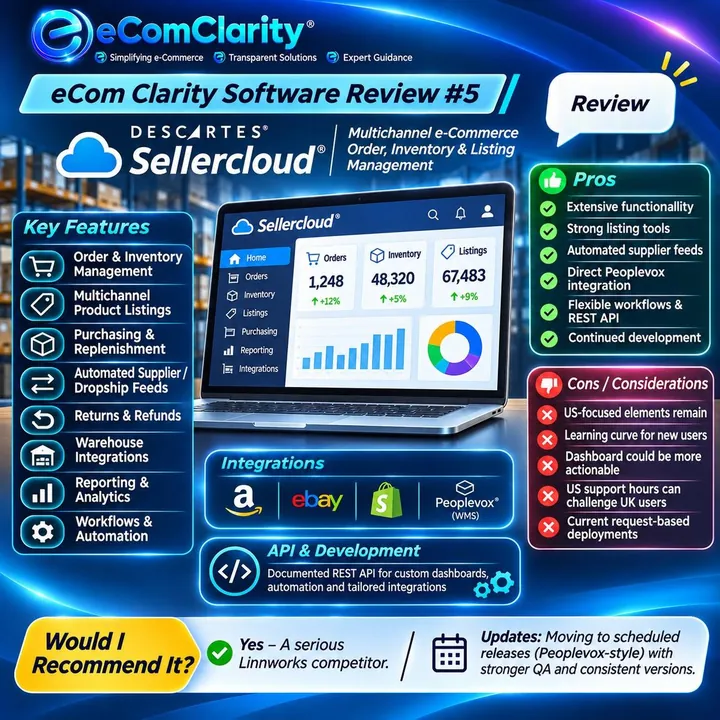
What Sellercloud is, and what it is not
Sellercloud is an order and inventory platform for sellers operating across several channels. Its own description is “the OMS for multichannel control”, and that is accurate: orders from every channel land in one place, inventory is synchronised out to all of them, listings are managed from a central catalogue, purchasing is handled alongside, and the whole lot is visible in reporting. Shipping and warehouse functions sit on top of that core.
Descartes bought Sellercloud on 14 October 2024, and the product is now sold as Descartes Sellercloud alongside Peoplevox, ShipRush and Skustack, with Sellercloud’s own Memaila shared inbox in the same suite and ForecastMine the more recent arrival. The acquisition matters for two reasons: it puts an order platform next to a warehouse platform in one group, and it means the roadmap now answers to a Canadian-listed parent rather than an Atlanta software company.
The boundary that decides whether it fits
Sellercloud will run a warehouse, but it is not a specialist WMS. Basic warehouse management is in Essentials; the advanced workflows — mobile picking, packing, receiving — come with the Skustack module on Growth. Most operations we see pair it with a proper WMS instead, which is exactly what the native Peoplevox integration is for.
How this review was done
We moved from Linnworks to Sellercloud in February 2025, so these judgements come from 21 months of running the platform rather than a demo. The factual claims — pricing, features, the Peoplevox integration, the update process, the API — come from Sellercloud’s and Descartes’ published material, read on the dates below, so they can be checked and argued with.
- The pricing page, including the plan comparison, read 9 November 2026
- The features and integrations pages: the module list and 350+ integrations
- The Peoplevox integration documentation: five articles covering account, listings, orders, inventory and transfers
- The “Server Update Process” article, which describes how deployments actually work
- The support page and the Descartes acquisition announcement of 14 October 2024
- The API documentation, and 21 months of building against it
Where I cannot verify something — the timing of the planned release schedule, for instance — it is described as our understanding rather than as a fact about the product.
Orders and inventory: the core is genuinely strong
This is what you buy it for, and it holds up. Every channel feeds one order queue, and the Order Rule Engine applies your own logic to what happens next — routing, holds, statuses, notifications — so a rule you write once stops being a daily decision. Supporting machinery is all there: scheduled tasks, queued jobs, saved searches, company and warehouse structures, and unit-of-measure handling for sellers whose products do not ship one-to-one.
Inventory is synchronised out to the channels with per-channel settings, rather than a single number pushed everywhere. For a multichannel business that is the difference between a shared buffer and a sellable quantity per marketplace, and it is the reason people move off simpler tools.
The trade-off is the interface. It is dense, because it is describing a lot of reality, and the first month is spent learning where things live. After that it is fast, but it is not a product that flatters a new user.
Listings: the catalogue does the work
Product data is held centrally and pushed to channels, so a listing is a view of the catalogue rather than a separate record you maintain by hand. Channel requirements — the fields each marketplace insists on — are handled in the listing tools, and the integrations page counts 150+ channels alongside 20+ shopping carts. For a seller on Amazon, eBay, Walmart and their own store, that is the bread and butter, and it is well done.
This has been one of the two strongest parts of the platform for us. The listing tools cope with the annoying realities: different required attributes, different image rules, products that exist on one channel and not another.
Purchasing, dropship and supplier feeds
Purchasing is a first-class module rather than an afterthought: purchase orders, vendor records, totals, and predictive purchasing on every plan. Sellercloud’s integrations page lists a Vendors category, and its support tiers include dropship setup as a distinct service — which tells you how much of its customer base buys stock it never touches.
The automated dropship stock imports have been the other standout for us. Stock positions from suppliers arrive without anybody opening a spreadsheet, which removes a recurring source of overselling and a genuinely miserable weekly job.
Automation and the rule engine
Automation is spread across the platform rather than concentrated in one screen: the Order Rule Engine for order logic, scheduled tasks for recurring work, queued jobs for long-running operations, and plugins for adding behaviour without leaving the platform. What it is not is a visual workflow builder — the logic is configured in Sellercloud’s own terms, which is powerful once learned and not something to discover on day one.
Returns, reporting and accounting
Returns are handled through an RMA module with its own settings and API services, so return authorisations, reasons and dispositions stay attached to the order. Reporting covers sales performance by product and channel, and the platform includes an accounting module for financial tracking rather than leaving you to reconcile elsewhere.
Reporting is extensive — genuinely, not as a bullet point. The caveat is the dashboard. It reports; it does not direct. When I open a system in the morning I want it to tell me what needs attention today: orders held, stock about to run out, listings rejected. Sellercloud gives me the numbers and the filters to find those things, and expects me to build the view. That is a reasonable position for an API-first platform, and it is still a gap.
Warehouse and the Peoplevox integration
Sellercloud has its own warehouse functions, and its Skustack module adds mobile picking, packing, receiving and inventory workflows for operations that want the warehouse run from the same platform. But the more interesting arrangement — and the one we run — is Sellercloud as the order and inventory brain with Peoplevox as the warehouse.
That integration is native and properly documented, across five areas: account integration, listings management, orders, inventory and purchase orders, and warehouse inventory transfers. The orders side exports orders into Peoplevox, tracks fulfilment status back, and maps shipping methods. It works through API calls between the two systems, and it needs the groundwork done properly: warehouses mapped to Peoplevox locations, and the Peoplevox item code mapped to the Sellercloud SKU where they differ.
What the integration actually means day to day
Orders do not get re-keyed, stock does not get reconciled by hand, and the warehouse keeps its own picking workflow. Where it needs attention is the mapping: a SKU whose Peoplevox item code differs from its Sellercloud SKU will fail quietly until somebody notices the order is stuck. Get the mapping right and it is invisible, which is the point.
The API: the reason to choose it
Sellercloud is an API-first product in the way that matters: the capabilities you use in the interface are exposed as documented REST services, with Swagger documentation and service families covering orders, RMA, purchasing, inventory, catalog, shipping and settings. It is not a read-only reporting API bolted on afterwards.
For us this has been the difference between buying software and owning a platform. On top of it we have built operational dashboards, stock automation, purchasing tools and the integrations that let the rest of our stack talk to it. When something in the interface is not how we want to work, the answer is usually “call the API” rather than “raise a feature request”.
That is also the honest test for a buyer: if you have nobody who can use an API, you will be paying for flexibility you never touch, and the interface alone is a harder sell against a simpler tool.
Pricing: per order, not per user
Sellercloud publishes its plans, which is still worth noting in this category. The model is per-order rather than per-user: unlimited users, plugins and integrations on every tier, no revenue share, and a subscription that is typically annual. The figures below are from the pricing page as read on 9 November 2026.
| Plan | From | What it covers |
|---|---|---|
| Essentials | $1,349/month | Inventory and product management, order management and rules, listing management, predictive purchasing, basic warehouse, shipping, reports, API access, email/phone/Zoom support and 24/7 emergency support |
| Growth | $1,998/month | Everything in Essentials plus advanced warehouse management through the Skustack WMS module: mobile picking, packing, receiving and inventory workflows |
| Enterprise | Custom | Everything in Growth with enterprise support, private cloud hosting, custom applications and integrations, and service levels aligned to the operation |
Two things to pin down in a quote: what your order volume does to the price, since the page is explicit that final pricing depends on volume and fulfilment mix; and what is a paid add-on versus included, because “unlimited integrations” does not necessarily mean unlimited bespoke work.
Localisation: the American accent is still there
Sellercloud is an American product — Descartes’ announcement describes it as US-based and based in Atlanta — and after 21 months that still shows. We occasionally meet dollar signs where we expect pounds, and US marketplace and carrier references in places where a UK seller expects their own. None of it is a blocker. All of it is friction that a UK team notices every week.
It matters most during onboarding, when new staff are learning the system and every unfamiliar reference costs a question. It matters least once the workflows are bedded in. But for a platform being sold into the UK alongside Peoplevox, which is UK-based and prices in pounds, the contrast is noticeable.
Support and releases: the part that is changing
Support is included on every plan — email, phone and Zoom, with 24/7 emergency cover — and Sellercloud sells named representatives at higher tiers, including training hours and setup work. In practice the constraint is time zone: support runs on US hours, which for a UK operation means the working day overlaps only partly. Our experience is that things get answered, and that the rhythm is American.
The release model is the more interesting part, because it is documented. Sellercloud’s own “Server Update Process” article describes how it works: a feature or fix is ready, support tells you an update is needed, an update request is submitted, it waits as pending approval until a stable version has been tested and approved, and only then is it applied. That is request-based deployment, and it means your environment changes when you ask rather than on a schedule.
Our understanding is that this is moving towards scheduled releases, more in line with how Peoplevox ships: consistent versions, stronger QA, and less dependence on a request being raised and tracked. We have not seen that land yet, so treat it as a direction of travel rather than a current feature. If it does land, it removes one of the two structural differences between the two Descartes products we run.
Who it suits, and who it does not
A good fit when
- You sell across several marketplaces and stores and need one order and inventory brain
- You are outgrowing Linnworks or a spreadsheet-led operation and want room above you
- You have technical resource — or a partner — who will actually use the API
- You run a WMS alongside it, Peoplevox especially, and want a documented integration rather than a bridge
- You want unlimited users and integrations rather than a per-seat bill that punishes growth
Not such a good fit when
- You need a warehouse system and an order system in one product — look at how Skustack or a WMS pairing changes the price
- You need UK localisation out of the box rather than as a roadmap item
- Your support needs are tied to UK office hours at the highest severity
- You want a dashboard that tells you what to do next, rather than one that reports what happened
- Nobody in the business can build against an API: you would be paying for the best part and not using it
What to ask Descartes Sellercloud in a demo
- Show our order rule set being built: three conditions, one action, then a change to it.
- How is inventory allocated per channel, and what happens when two marketplaces sell the last unit at once?
- Which parts of the interface are localised for the UK today, and which are not?
- What are the real support hours for us, and what does 24/7 emergency cover actually include?
- When does our environment get updated, and how much notice do we get?
- What is in the Peoplevox integration without custom work, and what needs mapping or building?
- How is pricing affected by order volume, and what is an add-on rather than included?
- Show me the API documentation for the two services we would use first.
The verdict
Moving from Linnworks to Sellercloud was a big change, and 21 months in I am glad we made it. The functionality is extensive, the listing tools cope with real marketplace mess, and the automated dropship stock imports have quietly removed a weekly chore that used to eat a day.
The standout is the API. Being able to reach the data and build our own dashboards, stock automation and purchasing tools has meant the platform bends to our operation instead of the other way round. That is rarer than it should be, and it is why I would shortlist it again.
The caveats are real and mostly British. The localisation is incomplete, the support rhythm is American, and the dashboard reports rather than directs. Request-based releases are a structural difference from Peoplevox, and the move to scheduled releases is welcome when it arrives rather than now.
Would I recommend it? Yes — as a serious Linnworks competitor and, for a multichannel seller with technical capability, a better long-term platform. Go in expecting to configure it, not to be looked after by it.
Evidence and sources
- Pricing page and plan comparison: from $1,349/month Essentials, $1,998 Growth, Enterprise custom · Read 9 November 2026
- Features and integrations pages: module list, 350+ integrations, 150+ channels, 20+ carts · Read 9 November 2026
- Knowledge base, Peoplevox integration: account, listings, orders, inventory and POs, warehouse transfers · Read 9 November 2026
- Knowledge base, “Server Update Process”: how deployments are requested and approved · Read 9 November 2026
- Support page: plan support levels, dedicated representatives, dropship setup · Read 9 November 2026
- Descartes announcement, 14 October 2024: acquisition, US base, IMS/OMS positioning · Read 9 November 2026
- API documentation: REST services and Swagger · Read 9 November 2026
- 21 months of running Sellercloud in a live multichannel operation · Author’s own
Independence
eCom Clarity was not paid for this review and Descartes Sellercloud has no influence over its content. There is no referral or affiliate arrangement. The facts come from Sellercloud’s own documentation and Descartes’ acquisition announcement, read on the dates below. The judgements — including the localisation, support-hours and dashboard points — come from running our business on it since February 2025, and are labelled as ours rather than presented as vendor claims.
Spotted something wrong, or used this product yourself? Tell us and we will correct or add it.